1 Hour Transcription: How Long? Costs & Time Explained!
Suokoshi, Kebatori, Seibun: The 3 Transcription Formats Explained
Oct. 9, 2026

I want to learn about "suokoshi," "kebatori," and "seibun" in transcription!
When transcribing audio or tape recordings, it is important to understand the three formats: "suokoshi," "kebatori," and "seibun."
Whether it is writing meeting minutes, producing interview articles, or analyzing audio for research, the situations in which audio has to be turned into text are growing rapidly in today's business world.
But when it comes to actually transcribing, many people are unsure which format to choose.
If you do not choose the right format, you may not get the results you expected, even after going to the trouble of converting speech to text.
In this article, we explain in detail the differences between suokoshi, kebatori, and seibun, their characteristics, and the situations in which each is used.
By the time you finish reading, you will surely have found the transcription format that is best for your purpose!
From suokoshi to kebatori and seibun! A recommended AI transcription service
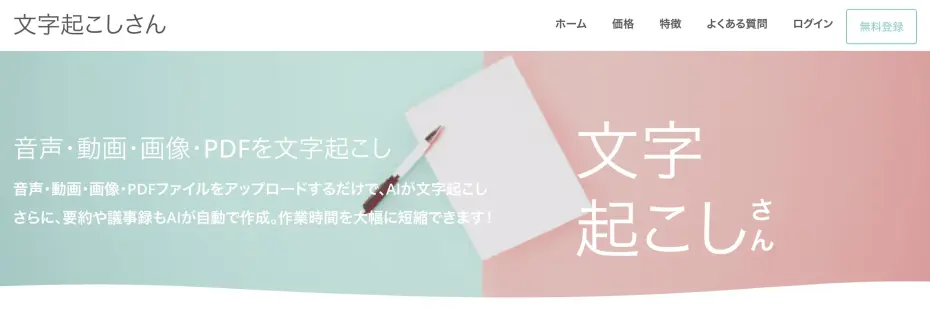
For transcribing audio and tape recordings, we recommend "Mr. Transcription"!
"Mr. Transcription" is an AI transcription service that converts speech to text quickly and accurately with the latest AI.
Even long audio files can be transcribed in only about 1 minute, so anyone can convert audio to text easily and efficiently.
What is more, "Mr. Transcription" is free to use!
Why not try "Mr. Transcription" first?
The basics of "suokoshi," "kebatori," and "seibun" in audio and tape transcription

First, here is a quick explanation of the basics of the following terms, which matter in audio and tape transcription:
- Suokoshi (verbatim transcription)
- Kebatori (clean verbatim transcription)
- Seibun (edited transcription)
Let us get started!
What are "mojiokoshi" and "tape-okoshi" (transcription)?
Mojiokoshi and tape-okoshi are basically used to mean the same thing.
In the past, recording media such as cassette tapes and MiniDiscs were mainstream, so the work was called "tape-okoshi" (literally, writing out from tape).
Today, digital audio files have become common, so the term "mojiokoshi" (literally, writing out as text) has become the main one.
Both terms refer to "the work of converting recorded audio into text."
It used to be done by typing on a keyboard, but in recent years, automatic transcription with AI has become the mainstream.
Work that once had to be outsourced to a specialist company can now be finished in a short time with an AI service.
Audio and tape transcription is divided into three types: suokoshi, kebatori, and seibun.
Why transcription is divided into three types: suokoshi, kebatori, and seibun
There is a reason why transcription is divided into three formats.
Even if you simply turn speech into text, the level of polish and quality required differs greatly depending on the purpose.
Word-for-word accuracy matters when a transcript is used as legal evidence, but for ordinary meeting minutes, readability takes priority.
When the text is to be published, a high level of polish is needed.
Cost and time also differ greatly depending on the format.
By choosing the right format, you can reduce cost and effort while securing quality that suits your purpose.
The standard classification in the transcription industry
In industries related to audio and tape transcription, the following three categories are used as the standard:
- Suokoshi (verbatim transcription)
- Kebatori (clean verbatim transcription)
- Seibun (edited transcription)
These are the three categories used as the standard.
When you transcribe audio, it is important to specify clearly which of these three formats you want.
The best format differs depending on the purpose, so we recommend changing the method depending on how you will use the transcribed text.
Next, let us look at the characteristics of suokoshi, kebatori, and seibun one by one!
What is suokoshi? The characteristics of this transcription format

First, we explain what kind of method suokoshi is, along with its characteristics and key points.
Characteristics of suokoshi: transcribing exactly as spoken
Suokoshi is a transcription format that converts recorded audio into text exactly as spoken, word for word.
As the character "素" (su, meaning "plain" or "unprocessed") suggests, nothing is processed, and the content of the audio is written out as text just as it is.
Its defining feature is that it records every word the speaker actually said, including hesitations and slips of the tongue.
Because it is a recording method that leaves out nothing, it can be called a transcription format that places priority on a complete reproduction of the audio.
Elements recorded in suokoshi
In suokoshi, the following elements are also all transcribed and recorded.
- Hesitations such as "uh," "um," and "hmm"
- Repeated expressions such as "well, well, well, you see"
- Interjections and exclamations such as "I see" and "that's right"
- Parts where the speaker corrected themselves midway
- Incomplete sentences such as "Um, the meeting next week, no, next month, that is"
- Laughter, coughs, and sighs
By transcribing hesitations and non-verbal elements as they are, you can record the speaker's emotions and the situation in the text.
When is suokoshi needed?
A characteristic of suokoshi is that it leaves the least room for the transcriber's subjective judgment.
For that reason, it is used in situations where objectivity and accuracy matter most.
Suokoshi is especially important for evidence in court, such as written transcripts of trial recordings.
Suokoshi is also chosen where testimony and statements must be recorded accurately.
If the content of a statement is changed even slightly, it loses its value as evidence, so the suokoshi method is strictly defined for legal purposes.

[Latest for 2026] Complete recording transcription for free! How to easily transcribe audio files
What is recording transcription (rokuon hanyaku)? We explain how to transcribe audio files in just 1 minute with the latest AI. Get highly accurate transcription in less time and at lower cost than hiring a specialist company.
Suokoshi is also often used for interview data for research.
In linguistics and psychology research, hesitations and self-corrections are also important subjects of analysis.
Suokoshi is also suitable when you want to analyze a speaker's characteristics and habits.
For purposes where the accuracy of the content is the top priority, suokoshi is the most reliable format.
How suokoshi relates to audio and tape transcription
Suokoshi is the most fundamental format of audio and tape transcription.
The other two formats (kebatori and seibun) can be seen as edited versions that start from suokoshi.
First, the audio content is fully converted to text as suokoshi, and then kebatori or seibun processing is applied as needed.
Suokoshi is characterized by giving top priority to completeness and fidelity.
It is a transcription format that works very well with AI speech recognition.
A concrete example of suokoshi
Let us compare actual audio with the suokoshi result.
Audio: "Uh, about the meeting next week, oh, no, next month, well, I'd, um, like to confirm the number of participants."
Suokoshi result: "Uh, about the meeting next week, oh, no, next month, well, I'd, um, like to confirm the number of participants."
As you can see, hesitations and self-corrections are all transcribed and recorded as they are.
How much detail to record depends on the purpose and the client's request.
Even in suokoshi, short sounds such as "uh" or "um" that do not affect the meaning are sometimes not recorded.
However, when strict transcription is required, as with legal records, such parts must be recorded as well.
[AI recommended!] Suokoshi is the most difficult transcription method
Suokoshi may seem easy at first glance, but it is actually the most difficult of the three transcription methods.
Because the audio must be transcribed completely as it is, you need to replay the audio many times to check the content, even for parts that are hard to hear.
When several people speak at once, it becomes even harder to tell the speakers apart.
Maintaining concentration while keeping accuracy takes considerable skill and experience.
That is why we recommend using an AI transcription service for suokoshi.
With an AI transcription service, you can convert audio to text far more easily than by listening and typing on a keyboard.
If you are unsure how to do suokoshi, why not try automatic transcription with "Mr. Transcription"?
What is kebatori? A commonly used transcription method explained

Next, we explain what kind of transcription method kebatori is.
Characteristics of kebatori and the meaning of "keba"
Kebatori is a transcription format that removes unnecessary parts when converting audio to text, making it easier to read.
"Keba" (literally, fuzz or lint) refers to elements that are unnecessary in written text, such as meaningless hesitations and needless repetition.
By removing unnecessary elements, you can produce text whose content is easy to understand.
Kebatori is a practical transcription format that balances readability with the content of the original remarks.
The key is to remove the habits peculiar to spoken language to a reasonable degree while keeping the speaker's intent and atmosphere.
Elements removed or tidied up in kebatori
In kebatori, meaningless or unnecessary elements are removed or tidied up as needed.
- Meaningless hesitations such as "uh," "um," and "hmm" are deleted
- Meaningless repetitions such as "well well well" are tidied up
- Digressions that stray from the main thread of the talk (deleted as needed)
- Unconscious verbal tics such as "I mean" and "like"
- Overuse of conjunctions, as in "and, and, but"
- Throat clearing and filler sounds that do not affect the meaning
However, deciding what to remove and what to keep requires specialized skill.
You need to understand the speaker's intent and judge appropriately which parts are unnecessary.
Elements kept in kebatori
Conversely, there are also elements that are actively kept when transcribing with kebatori.
- Interjections such as "I see" and "that's right"
- Words that express the speaker's feelings, such as "really" in "I'm really in trouble"
- Parts that show emphasis or emotion
There are also elements that are partly deleted and partly kept.
For example, for an important correction such as "the meeting next week, no, next month," only the corrected content is recorded.
A repetition that is necessary in context, such as "an important, important meeting," may be kept in some cases.
Criteria and rules for kebatori
When deciding what to keep and what to cut, the most important thing is not to damage the meaning of the text.
The text is edited so that what the speaker wants to convey reaches the reader accurately.
Appropriately preserving the speaker's intent and feelings is also an important criterion.
The aim is to balance improved readability with accuracy of content.
When in doubt, priority is given to keeping more information.
When is kebatori used?
For ordinary meeting minutes, kebatori is the most commonly used format, because it records the content of the meeting accurately while leaving it in a readable form.
Kebatori is also suitable for notes that become the basis of interview articles.
Before the material is turned into an article, it can be used as organized text.
Kebatori is also often used for materials from seminars and lectures, and for documenting training content.
For records of online business meetings too, kebatori is chosen for efficient information sharing.
With kebatori, you can create records that participants can easily review later.
3 ways to transcribe web meetings! How to make writing minutes more efficient
We explain, with images, how to transcribe web meetings on ZOOM, Microsoft Teams, and Google Meet, including the detailed steps and tips for choosing a method.
[Morning assemblies and regular meetings] Kebatori is also the best format for records of offline meetings
Kebatori is also the best format for transcribing meetings that are not held online, such as morning assemblies and regular meetings.
Until now, unlike online meetings such as ZOOM or Microsoft Teams, it was difficult to keep a written record of what was said in in-person meetings.
But now, with the latest AI tools, you can transcribe the content of morning assemblies and regular meetings and easily create minutes.
By keeping detailed written records, you can also make instructions clear and prevent "I said it" / "no, you didn't" disputes.

Make minutes for in-person morning assemblies and regular meetings more efficient! How to smoothly convert them to text with an AI transcription service
Transcribe morning assemblies and regular meetings for free! With the AI "Mr. Transcription," minutes are ready from a recording file in just 1 minute. Free yourself from handwritten notes and focus on the meeting. Make recording in-person meetings more efficient.
How kebatori relates to audio and tape transcription
Kebatori is the most widely used format in audio and tape transcription.
Because it balances practicality and readability, it is the standard format for business transcription.
Text in the kebatori format is created by removing unnecessary parts from suokoshi.
It does not require editing skills as advanced as seibun, and it costs less in money and time.
You can also apply kebatori yourself to text transcribed by an AI transcription service.
A concrete example of kebatori
For kebatori too, let us look at an actual example of audio and tape transcription.
Audio: "Uh, about the meeting next week, oh, no, next month, well, I'd, um, like to confirm the number of participants."
Kebatori result: "About the meeting next month, I'd like to confirm the number of participants."
As you can see, in kebatori, only meaningless parts of the recorded audio, such as
- uh
- oh, no
- well
- um
are deleted, and the rest is transcribed.
Parts in spoken (colloquial) language, such as the contraction "I'd," are left as they are.
Tips for kebatori work and how to make it more efficient
To carry out kebatori efficiently, it is important to first listen to the whole recording.
Grasp the flow of the talk and the key points before starting to edit.
A common mistake is deleting an important self-correction.
For corrections such as "next week, no, next month," you need to keep only the correct information.
If you use an AI-based transcription service, you can make kebatori work far more efficient too.
Why not use "Mr. Transcription" to transcribe efficiently, too?
What is seibun? The characteristics of this advanced transcription method

Next, we explain the characteristics of seibun.
Characteristics and purpose of seibun
Seibun is a transcription format that edits the transcribed content into a polished text that is easiest for the reader to understand.
It removes the wordiness and vagueness typical of spoken language and produces text that is appropriate as written language.
By editing for the reader's ease of reading, the aim is to make the content easy to understand.
It is a very advanced transcription format that aims for publication-level quality.
Characteristics of the editing done in seibun
When transcribing with seibun, grammatical corrections and adjustments are necessary.
Subjects and predicates that were vague in spoken language are made clear, so that each sentence is complete.
Changing word order to make the text easier to read
In seibun, word order is changed to adjust the text into a structure that is easy to read.
"Yesterday, in the meeting, the manager, about sales, talked."
An unnatural word order like this is corrected to a natural one, as in
"Yesterday in the meeting, the manager talked about sales."
The word order is corrected to read naturally, like this.
Editing wordy expressions to make them readable
In seibun, making wordy expressions concise is also an important task.
"...what I am trying to say is that, basically, ..."
A roundabout expression like this is made concise, as in
"...in short, ..."
Such roundabout expressions are made concise, like this.
Other editing points in seibun
Besides these, editing includes things such as:
- Converting spoken language into written language, as in "I kind of think that..." → "It is considered that..."
- Rearranging inverted sentence structures and similar constructions
- Unifying the style of writing (for example, not mixing formal and casual styles)
- Replacing technical terms with easy-to-understand words to suit the reader
These are some of the edits that are made.
When is transcription with seibun used?
Seibun is used above all for publications and official documents.
When the text is used in publications such as books and magazines, or in articles on official websites, text that is easy for readers to read is needed.
Seibun is of course also chosen for documents announced as the official position of a company or organization, minutes of shareholder meetings, and records of board meetings.
Seibun is also used for official government documents and public documents such as annual reports and white papers.
A concrete example of seibun
Here is an example transcribed with seibun as well.
Audio: "Uh, about the meeting next week, oh, no, next month, well, I'd, um, like to confirm the number of participants."
Seibun result: "Regarding next month's meeting, I would like to confirm the number of participants."
As you can see, compared with the original audio, not only have meaningless parts such as "uh" and "oh, no" been deleted, but the sentence has also been substantially rewritten.
However, you can also see that the content and meaning of the sentence itself have not changed.
How seibun relates to audio and tape transcription
Among the formats of audio and tape transcription, seibun is the most advanced and most polished format.
Unlike suokoshi and kebatori, it requires editing work that goes beyond simply converting audio to text.
It can be called an essential format for creating high-quality documents.
It takes time and money, but the result is worth it.
Because it is very demanding work, it is important to reduce time and effort as much as possible wherever that can be done.
When you prepare a manuscript to be transcribed with seibun, using the AI transcription service "Mr. Transcription" lets you proceed even more smoothly.
Suokoshi, kebatori, and seibun | Comparing examples of the three transcription types
Let us compare the results of the three types of audio and tape transcription introduced as examples.
Audio: "Uh, about the meeting next week, oh, no, next month, well, I'd, um, like to confirm the number of participants."
Suokoshi result: "Uh, about the meeting next week, oh, no, next month, well, I'd, um, like to confirm the number of participants."
Kebatori result: "About the meeting next month, I'd like to confirm the number of participants."
Seibun result: "Regarding next month's meeting, I would like to confirm the number of participants."
With suokoshi, you can see that the content of the audio is transcribed as it is.
With kebatori and seibun, on the other hand, you can see that unnecessary parts are deleted or the content is edited, depending on the purpose and goal of each.
With any transcription method, AI tools let you get the work done quickly and smoothly.
Why not experience automatic speech-to-text conversion with the AI transcription service "Mr. Transcription" yourself?
How can you carry out audio and tape transcription efficiently?

Problems with audio and tape transcription until now
Transcription until now has had many problems.
Transcribing by listening and typing on a keyboard takes 4 to 6 hours of work for 1 hour of audio.
Another major problem was that quality varied depending on the transcriber's skill and experience.
Commissioning a specialist company also meant high costs, which raised the barrier to making use of audio data.
Turnaround times were long as well, from several days to several weeks.
Solving the problems of audio and tape transcription with AI technology!
That is why we recommend using an AI transcription service.
Thanks to improved accuracy in automatic speech recognition, you can now convert audio to text with very high accuracy.
Processing speed has also improved significantly.
Even long recordings can be transcribed in only about 1 minute.
Using AI services for audio and tape transcription
AI transcription services can be used for all three formats.
For suokoshi in particular, you can simply use the output of the AI transcription service as it is.
Because AI does not make subjective judgments the way humans do, objective suokoshi is possible.
For kebatori and seibun as well, by having a human edit the AI's output, you can create high-quality text far more efficiently than before.
For suokoshi, kebatori, and seibun, we recommend "Mr. Transcription"!
"Mr. Transcription" is an AI transcription service that can be used for all three types: suokoshi, kebatori, and seibun.
With the latest AI speech recognition engine, even long recordings are transcribed with high accuracy in only about 1 minute.
It delivers major time savings in transcription across a wide range of fields, such as meeting minutes, interview articles, and academic research.
With transcription that is objective, as only AI can be, you can prevent human error.
After transcribing with AI, all you have to do is check the text against the original audio, and the conversion to text is done smoothly.
With "Mr. Transcription", you can easily keep records not only of online meetings such as ZOOM and Microsoft Teams, but also of offline meetings such as morning assemblies and regular meetings, which were hard to record until now!
It supports 100 languages, so you can transcribe not only Japanese but also foreign languages.
What is more, "Mr. Transcription" is free to use!
You can start using it for free with no registration or login, so why not try "Mr. Transcription" first?
Understand kebatori, suokoshi, and seibun for smooth transcription (tape transcription)
In this article, we have explained the three formats of audio and tape transcription in detail.
Suokoshi emphasizes completeness and fidelity and is best suited to legal and research uses.
Kebatori emphasizes practicality and balance and is the format most widely used for general business purposes.
Seibun emphasizes polish and quality and is suited to publishing and the creation of official documents.
By choosing the right format from the three, you can obtain the output best suited to your purpose.
Transcription work that once required a specialist company can be made far more efficient with AI technology.
With the AI transcription service "Mr. Transcription", you can work far more smoothly than before in any format: kebatori, suokoshi, or seibun.
Why not choose the transcription format that best suits your purpose and transcribe efficiently?
To start, we recommend experiencing the accuracy and speed of AI transcription yourself with the free-to-use "Mr. Transcription"!
■ AI transcription service "Mr. Transscription"
"Mr. Transcription" is an online transcription tool that can be used from zero initial cost and 1,000 yen per month (* free version available).
- Supports more than 20 file formats such as audio, video, and images
- Can be used from both PC and smartphone
- Supports technical terms such as medical care, IT, and long-term care
- Supports creation of subtitle files and speaker separation
- Supports transcription in approximately 100 languages including English, Chinese, Japanese, Korean, German, French, Italian, etc.
To use it, just upload the audio file from the site. Transcription text is available in seconds to tens of minutes.
You can use it for free if you transcribe it for up to 10 minutes, so please try it once.

It is "Mr. Transcription" who can easily transcribe from audio, video, and images.
Transcription allows you to transcribe for up to 10 minutes for free.
You can copy, download, search, delete, etc. the transcribed text.
You can also create subtitle files, which is ideal for transcription of interview videos.
HP: mojiokoshi3.com
Email: mojiokoshi3.com@gmail.com
Email: mojiokoshi3.com@gmail.com
Related article
Transcription for audio / video / image transcription. It is a transcription service that anyone can use for free without installation.
- What is Mr. Transcription?
- Transcript images, sounds, and videos with Mr. Transcription
- Free registration
- Rate plan
- manual
- Try other free services