How Secure Is Mr. Transcription? Servers and More, Explained
Transcribe 10x Faster: Time-Saving Methods and Apps
Oct. 16, 2026
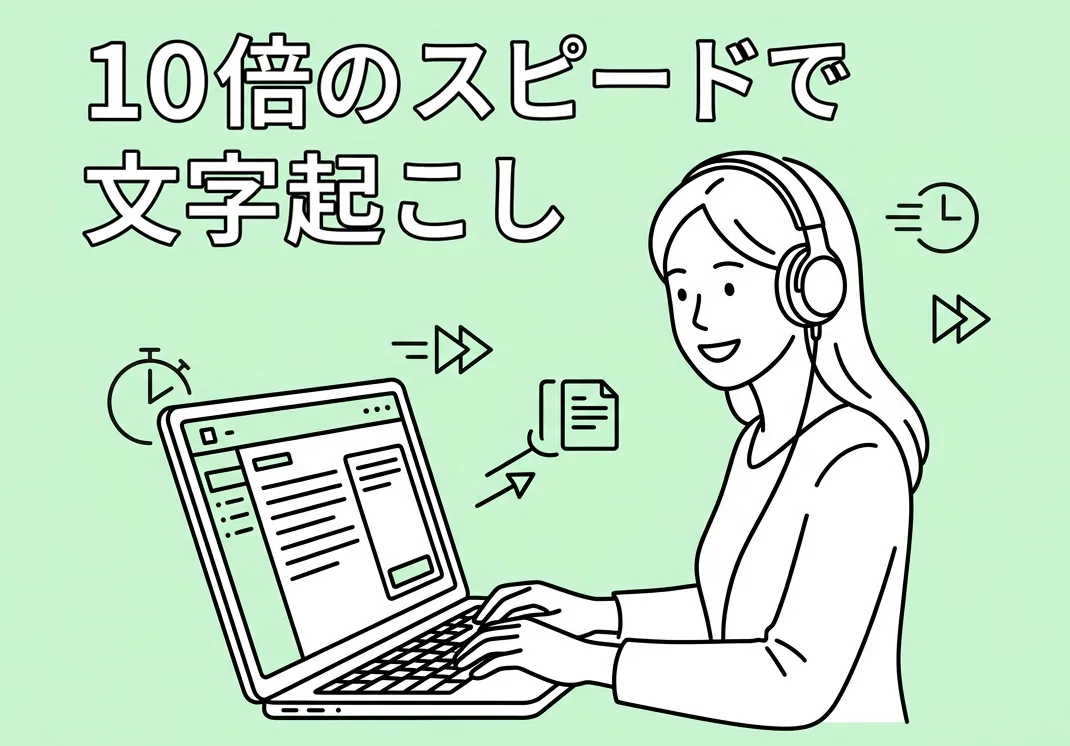

Transcribing is such a hassle (or at least it looks like one) ...
For anyone who feels exactly this way right now, this article explains fast and efficient ways to transcribe!
- You want to know exactly how to transcribe (steps and methods).
- Writing up meeting minutes or interview summaries takes you a long time … Is there a way to do it as efficiently as possible?
- You want to hear about handy tools and concrete techniques for using them.
This article gathers information that will help readers like you.
After reading this article, you should be able to cut transcription work that used to take hours down to a fraction, or even a small fraction, of the time and focus on work that earns you more.
Below we introduce ways to transcribe faster, so please read through to the end.
Let’s Make Transcribing More Efficient!

Transcription means writing out the content of audio or video as text, and the time and effort it takes actually vary greatly depending on how you go about it.
Thanks to technological progress, much faster ways to transcribe have appeared.
Recently, using an AI transcription service has also made it possible to become far more efficient all at once.
How Can You Transcribe Much Faster Than Before?
When you decide “Okay, time to transcribe!”, you probably picture a workflow like this, don’t you?
- You prepare the recording (or are handed one).
- You play the audio on an IC recorder or the built-in player of your smartphone or PC, and type out what you hear bit by bit in an editor such as Word.
- For passages you could not catch or could not keep up with, you press pause or rewind each time and fix them one by one.
Frankly, this approach is far too inefficient.
Even when you type by hand on a keyboard, checking the steps and doing some preparation (setting up your working environment) before you start lets you transcribe quickly in less time.
At first glance, diving straight into the work seems faster, but if you do not make a solid plan beforehand and start improvising without any preparation, you usually end up spending extra time overall.
Also, tedious work like transcription is exactly where AI comes in.
With AI transcription services such as “Mr. Transcription”, you can transcribe much faster than by hand, and with high accuracy too.
Now let’s look in concrete terms at the points to keep in mind for faster, more efficient transcription, as well as the steps and methods of transcribing.
How to Transcribe 10 Times Faster (5 Key Points)

First, let’s go over the key points for transcribing faster.
To transcribe quickly and efficiently in as little time as possible, you need to keep the following five points in mind.
- Make full use of tools and apps
- Optimize the audio data
- Listen through the audio once beforehand
- Do not stop the playback while working by hand
- Make your typing more efficient
I will explain each one in detail.
1. Make Full Use of Tools and Apps
The first thing to consider is using a tool made specifically for transcription.
It is easy to try to get everything done with the software that comes with your OS or standard Office apps you are used to.
However, using a “dedicated tool” specialized for your purpose makes the work far easier.
Of course, such “dedicated tools” exist for transcription as well.
Besides the “AI automatic transcription tools” that have been much talked about lately, there are also
- audio players made for transcription with easy playback control
- feature-rich editors that make detailed corrections and turning text into presentation materials or documents easy
- proofreading tools that check for mistakes in Japanese
A variety of handy apps like these are available.
Choosing the right tool for each task and using it effectively leads to time savings.
It may take a little effort until you get used to them, but the benefits you gain later are very large.
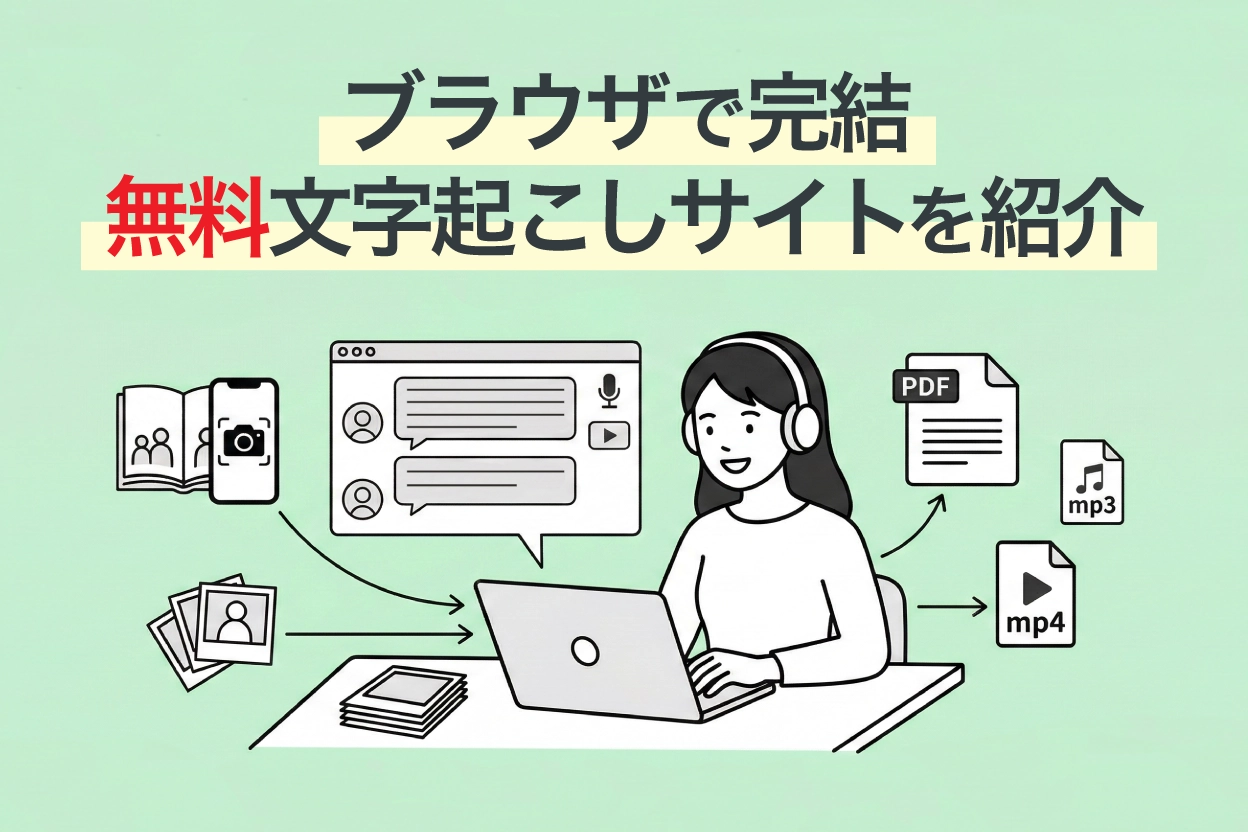
[Free] 5 Recommended AI Audio Transcription Sites: Browser Only, No Installation Needed [2026 Edition]
We compare 5 free sites that let you transcribe audio with AI right from your browser. They support audio, video, images, and PDFs, and we also introduce services that work without registration. We also explain how AI transcription works, how accurate it is, and where to use it.
2. Optimize the Audio Data
If the quality of the audio source (audio data) you are transcribing is poor, your efficiency drops dramatically and mistakes and errors become more likely.
If you make the recording yourself, place the best microphone you can near the speaker and record in an environment where surrounding noise is unlikely to get in.
If you already have recorded data, it is a good idea to “optimize” the data itself before transcribing, for example by removing distracting noise and adjusting the volume and playback speed so that it is easy to hear.
This lets you transcribe smoothly, which shortens the total working time and lets you finish transcribing sooner.
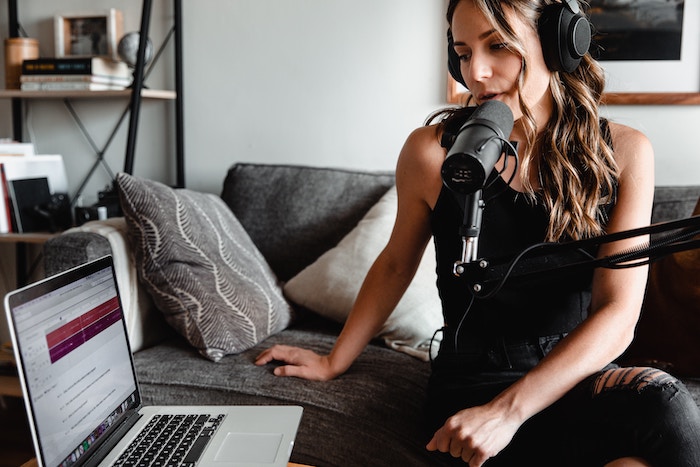
[AI Transcription] 6 Recording Tips for Highly Accurate Transcription
To get highly accurate AI transcription, a few techniques matter when you record. This article introduces the best recording tips for transcribing with AI. A high-quality microphone, a microphone in the right position, a quiet recording environment, clear speech from the speaker, one person ...
※ Even when you use an AI automatic transcription tool, the conversion is more accurate when the source data is clear.
Various dedicated apps are helpful here as well. I will explain the details in the next section.
3. Listen Through the Audio Once Beforehand
When you have taken on transcription work as an outsourced job and were not present at the event yourself, it is a good idea to listen to the audio data all the way through before starting to transcribe.
- What kinds of participants (speakers) are there, and roughly how many?
- What topic are they talking about?
- How many unfamiliar words are there?
Keeping these points in mind, try to get a general grasp of the whole recording; a rough picture is enough.
If you look up technical terms online in advance, the later work goes more smoothly and, as a result, you can finish sooner.
4. Do Not Stop the Playback When Transcribing by Hand
While transcribing by hand, when you cannot make out a passage you are tempted to stop and rewind the audio, aren’t you?
But no matter how easy to use your player is, if you pause and rewind every single time, the work will never be finished.
Mark passages you cannot understand with a symbol such as “●” along with the timestamp so that you can check them later, and first concentrate on getting through all of the content once.
You can finish transcribing much faster than if you paused or rewound every time.
If you cannot keep up with the typing in the first place and end up pausing frequently, it is a good idea to slow down the playback speed when you optimize the audio data.

5. Make Your Typing More Efficient
Naturally, the faster you can type, the more you can shorten the time spent on transcription.
Ideally, while listening to the audio, you can work without pausing as much as possible and be able to type (transcribe) at the same speed as the playback.
Besides sharpening your skills with typing practice software, it is also important to choose an easy-to-use keyboard that suits you.
Another technique for typing more efficiently is making good use of the handy features of the Japanese input system (IME).
I will also introduce that method in detail below.
Explained: Concrete Steps for Transcribing an Audio File (5 Steps)

Now that we have covered the key points, we will explain how to actually transcribe step by step.
- Recording
- Optimizing the audio file
- Verbatim raw transcription (with an automatic tool)
- Fixing the details
- Removing fillers and polishing the text
That is the general flow. I will explain the methods one by one.
[STEP 1] Recording
To transcribe faster and more smoothly, it is a good idea to record in a way that makes the audio easy to transcribe in advance.
As explained above, the better the quality of the audio source (audio data), the more accurate your transcription will be.
When recording with a smartphone or an IC recorder, using a high-performance external microphone makes higher-quality sound possible.
Depending on your workflow, when you are present yourself, such as for meeting minutes or interviews, there are also services that can transcribe at the same time instead of just recording audio with an IC recorder.
These tools support real-time recording plus transcription, so it is a good idea to use them selectively depending on your situation.
When the Sound Quality Is Poor, AI Transcription Is Recommended
The latest AI transcription services can skillfully tell voices apart and transcribe with high accuracy even when there is some noise or voices other than the main speaker.
At events such as lectures, for example, the microphone can pick up the murmuring of the audience.
AI engines for transcription are trained so that they can automatically recognize that kind of noise.
For that reason, an AI transcription service will smoothly turn audio into text even if the sound quality is somewhat poor.
High-quality microphones are expensive, so we recommend subscribing to an AI transcription service with the money you would spend on equipment.
[STEP 2] Optimizing the Audio File
As explained above, optimizing the recorded audio data so that it is easy to transcribe will save time in the later work.
The main things worth doing are the following three.
- Noise removal
- Volume adjustment
- Playback speed adjustment
It may sound difficult, but with a dedicated tool it is surprisingly easy.
These two are the ones we recommend.
When editing the audio data, it is a good idea to also prepare a sample file with a short clip (about 1 minute) cut out of the audio for the test in the next step.
[STEP 3] Verbatim Raw Transcription with an Automatic Tool
A “raw transcription” (called “suokoshi” in Japanese) means transcribing the content of the audio data word for word, exactly as it is.
※ Even when you transcribe by hand, the key is not to omit anything at all, including fillers such as “ah” and “um.”
Mechanical work like this is where tools truly excel.
Many transcription tools are free for short audio data, so try transcribing with the sample test data you created in the previous step using several tools and choose the one with the highest possible accuracy.
Compatibility with a tool depends on the audio file and the content of the conversation, so doing this test keeps you from wasting money.

You can try these tools for free, so they are recommended even for people who have never used this kind of tool.
Once you have narrowed down a promising tool (one that works well with the audio file you want to transcribe), the next step is to convert the audio file into text using your actual data.
If You Cannot Decide on an AI Transcription Tool, We Recommend “Mr. Transcription”
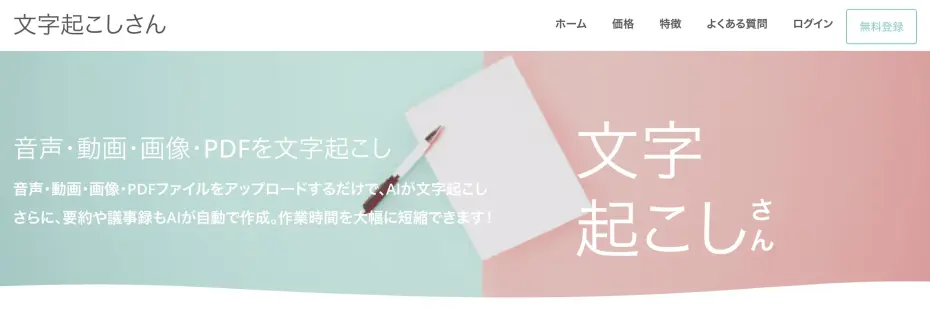
If you are unsure about the tool or method for transcribing audio, try “Mr. Transcription” first.
“Mr. Transcription” is an AI transcription service capable of highly accurate transcription.
With the latest AI transcription engine, even long audio can be transcribed with high accuracy in only about 1 minute!
Support for 100 languages is another feature.
Transcribing is also very easy, since all you do is upload a file from the top page, so you can use it without any confusion.
On top of that, you can try it for free for up to 3 minutes a day without registering, and with a free membership registration you can transcribe up to 10 minutes a day for free!
You can actually transcribe with AI right now.
Why not start by experiencing AI transcription with “Mr. Transcription”?
[STEP 4] Fixing the Details
AI transcription is very capable, but small mistakes or passages that were not transcribed may need to be written out by hand.
For correction work, we recommend using a dedicated transcription player of the kind that was already in use before AI transcription appeared.
Dedicated transcription players include software such as the following.
These dedicated players come with a variety of handy features specialized for transcription, such as playback control with hotkeys, support for foot switches (pedals), and the ability to operate them in the background without switching windows.
Using a dedicated tool lets you finish the work much faster, so do make use of it.

Some apps also come with an editor that has features such as cueing and timestamps.
Customizing the Japanese Input System (IME) Is Also Recommended
To finish transcribing sooner, it is also a good idea to tweak how you type Japanese.
By registering frequently used words and phrases in advance in the dictionary tool of the Japanese input system (IME) and making good use of the automatic conversion (live conversion) feature, you can reduce the number of keystrokes and speed up text input with little effort.
When working on a Windows PC, it is also a good idea to use conversion software other than the standard IME.
These two are the best-known options. If you are curious, give them a try.
Methods for transcribing by hand on a keyboard are explained in this article. Please take a look.
7 Tips to Dramatically Improve the Efficiency of Transcription (Tape Transcription)
For those who want to cut down the time spent on transcription even a little, this article explains tips for working efficiently. It also introduces specific recommended tools and points to watch out for before you start.
[STEP 5] Removing Fillers and Polishing the Text
A text that writes out the audio word for word (a raw transcription) is necessary as a record for the archive, but it is hard to use when you actually put it to work, isn’t it?
If you want to quickly refer back to the content later, compile it into materials, or publish it on a website or in print, you need to revise the text so that it is easy to read.
The following two types of revision are commonly performed in the world of transcription.
- Removing fillers (“kebatori”): taking out meaningless words such as “ah” and “um”
- Polishing the text (“seibun”): converting spoken language into written language
When polishing the text, also be sure to check the following points in particular.
- Incorrect expressions and phrasing
- Filling in missing parts (particles, demonstratives, etc.)
- Sentence breaks (punctuation)

What Is the Difference Between Raw Transcription, Filler Removal, and Text Polishing? The 3 Formats of Transcription Explained Thoroughly
The differences between raw transcription, filler removal, and text polishing explained thoroughly! Choose the right transcription format to work more efficiently. Using AI greatly shortens working time. Detailed introduction of the best method for each purpose.
Professionals who specialize in transcription make various other corrections as well, but even when you transcribe yourself, these revisions are the minimum that will be necessary.
※ Be careful: if you polish the text too much, the content may end up differing from what the speaker intended.
Using a “proofreading tool” that automatically checks for typos and mistakes in Japanese is also recommended for transcribing faster.
The three above are the well-known ones. Some can be used for free (including trial versions), so please try them for everyday writing as well.
Human Transcription Services Are Also Recommended
When you simply cannot set aside the time for the work, or urgently need clean transcription (text) data, using a professional transcription service is one option.
The scope of services varies widely, from “raw transcription only” to services that also handle filler removal and text polishing as a set.
If you want the transcription results as soon as possible, they can also accommodate a short turnaround for an additional fee.
Prices are often very reasonable, and there are also “per-character pricing plans” that make one-off orders easy, so you can choose the best cost-effective service for your purpose.
The three above are the well-known ones.
You can also commission transcription at low cost through crowdsourcing services, but be aware that it takes effort, such as vetting the person you hire and (in some cases) running a test beforehand.
Weighing the balance between time and financial cost, and comparing with AI transcription as well, use them as appropriate.

How Much Does Outsourcing Audio Transcription Cost? Tips for Ordering Cheaply Explained
For those who want to outsource transcription cheaply, we have compiled the going rates for audio transcription by AI, individuals, and specialist companies. We also cover tips for avoiding failure when outsourcing and techniques for ordering the highest-quality transcription possible at a low price.
Summary
This time, we explained tips, concrete steps, and methods for transcribing quickly and efficiently.
As explained at the beginning, there is an important point in transcription.
That is to set aside enough time to set up your working environment and make preparations.
There are three reasons.
- By understanding the overall flow and methods, you can think with a bird’s-eye view even while working.
- It is easier to estimate the working time, and you can respond flexibly to unexpected situations.
- It is easier to find the parts that can be made more efficient, that is, the places likely to take a lot of time (bottlenecks).
If you pay attention to these things, you can end up finishing the work in less time, even if it feels like a detour.
Not only for transcription but for any task, it is important to prepare rather than jumping straight in.
Smart people make solid plans, actively gather know-how and handy apps, and keep raising their productivity.
Please do try incorporating these ways of thinking, tools, and methods.
■ AI transcription service "Mr. Transcription"
"Mr. Transcription" is an online transcription tool that can be used from zero initial cost and 1,000 yen per month (* free version available).
- Supports more than 20 file formats such as audio, video, and images
- Can be used from both PC and smartphone
- Supports technical terms such as medical care, IT, and long-term care
- Supports creation of subtitle files and speaker separation
- Supports transcription in approximately 100 languages including English, Chinese, Japanese, Korean, German, French, Italian, etc.
To use it, just upload the audio file from the site. Transcription text is available in seconds to tens of minutes.

It is "Mr. Transcription" who can easily transcribe from audio, video, and images.
Free membership registration now!: 5 hours / month
You can copy, download, search, delete, etc. the transcribed text.
You can also create subtitle files, which is ideal for transcription of interview videos.
HP: mojiokoshi3.com
Email: mojiokoshi3.com@gmail.com
Email: mojiokoshi3.com@gmail.com
Try audio/image transcription for free
Try it nowRelated article
Mr. Transcription for audio / video / image transcription. It is a transcription service that anyone can use for free without installation.
- What is Mr. Transcription?
- Transcript images, sounds, and videos with Mr. Transcription
- Free registration
- Rate plan
- manual
- Try other free services