文字起こしさんのセキュリティはどうなっているの?サーバーなど、詳しく回答
8 Best Chinese Transcription Services & Key Considerations
Oct. 13, 2026


I don't even have satisfactory English skills, and I don't have time to learn Chinese...
Even if you feel that way, the changing times won't wait.
In recent years, globalization has been a buzzword for a long time.
In business, there are increasingly more situations where communication happens in languages other than English.

Especially Chinese, its importance is growing to be on par with or even greater than English, isn't it?
In the future, opportunities to engage with Chinese will undoubtedly increase.
In such situations, a powerful tool is a service that transcribes Chinese audio or PDFs into text (speech-to-text).
Using a transcription tool allows you to carefully review, translate, or check the accuracy of your Chinese after it has been converted to text.
Furthermore, by being able to thoroughly confirm the content in Chinese, you can significantly reduce the likelihood of misunderstandings in communication.
This time, we will introduce a carefully selected list of highly recommended Chinese transcription services.
This article also explains important points to consider when transcribing Chinese, so by reading it, Chinese will become much more accessible, and you'll find yourself hesitating less in both work and private life.
Please read to the end.
Recommended: 8 Chinese Transcription Apps and Services
Let's dive right into introducing recommended services and apps for Chinese transcription!
From easy-to-use AI transcription services available in Japan to services developed by local companies, please use this as a reference when choosing a transcription service.
1. Mr. Transcription
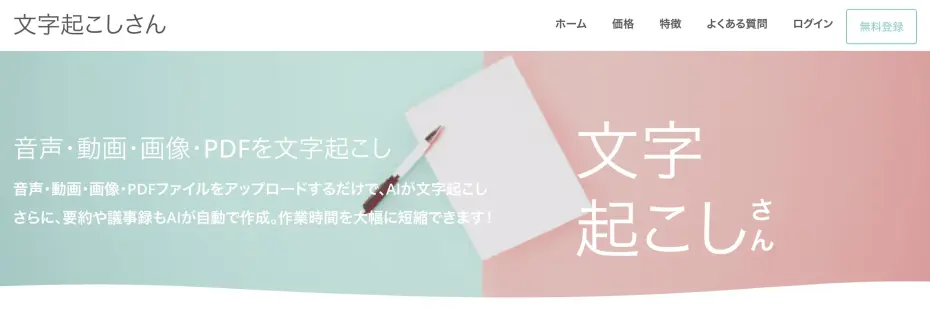
Mr. Transcription is an AI transcription tool that can be easily used from your browser.
In recent years, AI transcription accuracy has improved remarkably, allowing for highly precise and accurate transcriptions.
Mr. Transcription utilizes the latest AI speech recognition engine.
The latest AI supports transcription in 100 languages, including Chinese.
Speech recognition is a particularly practical field within AI, so even if you don't understand Chinese, you can easily grasp the content.
Afterward, you can use AI translation services like DeepL to translate it into Japanese.
A major feature is its ability to transcribe (textify) not only audio but also videos, images, and PDFs.
It's also incredibly easy to use; just upload your files from your browser.
You can try it for free for up to 3 minutes without registration, and free members can use it for up to 10 minutes per day, making it easy for first-time users of such transcription tools to get started.
If you're looking for Chinese transcription, try Mr. Transcription first.
2. Sogou Input Method

This is the Chinese input system (IME) by Sogou, a major Chinese search engine.
Similar to Japanese IMEs like Gboard (Android smartphone keyboard) or Shimeji (Android keyboard app), it functions as a standalone keyboard app, available for both smartphones and Windows.
It includes a voice input feature, so you can also use it as a speech recognition app.
In addition to being an input screen for other apps, it can also be launched independently as a standalone app, offering translation and image recognition features.
The accuracy of its voice input is higher than Google and other IMEs, which is reassuring for those less confident in their Chinese skills.
3. iFlyrec

This is a speech recognition app by iFlytek, China's largest AI voice recognition company.
The main characteristic of iFlyrec is its overwhelmingly high speech recognition accuracy.
※The AI developed by this company not only recognizes speech but also possesses comprehension (reading) abilities.

While it doesn't seem to support Japanese (translation is available on the web version), it does support English voice input, making it suitable for situations where multiple languages are spoken.
It also includes keyboard app functionality.
4.Yating

This is an audio transcription app provided by Taiwan AI Labs.
Developed by a Taiwanese company, a key feature is its ability to accurately transcribe Chinese with unique Taiwanese accents.
The app itself supports Japanese (confirmed on the iPhone version), making it user-friendly.
There are also Chrome extensions for real-time browser subtitles and speech synthesis apps, so it's recommended to explore various ways to use it.
5.ObotAI Minutes

This is a convenient tool for multilingual web conferences.
It runs in a browser, so no app installation is required.
It offers automatic translation for a wide range of languages, and AI transcribes audio in real-time.
Meeting minutes can be downloaded as files (txt/xls), which is useful for later translation.
This tool is recommended for transcribing meeting minutes in Chinese.
6.Amitt

This service is recommended for those who prefer professional transcribers to manually transcribe audio, rather than using AI transcription services.
Amitt is an audio transcription service provided by a company specializing in multilingual translation, interpretation, and overseas research.
A key advantage is the option to request Japanese translation simultaneously, and the pricing is very reasonable.
※For transcription where accuracy is paramount, human transcription is always more reliable.
Companies specializing in translation are often better suited for foreign language transcription than general transcription agencies.
Foreign Language Transcription Service | Amitt Co., Ltd.
7.文字语音转换大师 (Wénzì Yǔyīn Zhuǎnhuàn Dàshī)

文字语音转换大师 is a transcription service offered by Wuhu Jiejia Network Technology Co., Ltd. Jinan Branch in China.
It's easy to use; just open the page and upload your file, similar to Mr. Transcription.
However, a drawback is that it's difficult to use from Japan, as user registration through WeChat (Weixin), the most widely used chat app in China, is required.
As it's a service from the People's Republic of China, using it from outside China is challenging, but it could be very convenient if you're in China.
8.人工智能语音-Ai Voice (Rén Gōng Zhìnéng Yǔyīn - Ai Voice)

人工智能语音-Ai Voice is also an AI transcription service originating from China.
It's easy to use, allowing you to upload files directly to the website.
Developed by Anhui Zhongweike Computer Research Institute Co., Ltd., it's an AI service created by a computer research institute affiliated with a pharmaceutical manufacturer.
However, please note that as this is also a domestic Chinese service, an account like WeChat (Weixin) is required for registration.
If you need to perform transcription within China, this service can be a strong ally.
Important Considerations for Chinese Transcription

When transcribing Chinese audio or video, you might find that simply applying the same methods as for Japanese doesn't yield accurate text results...
For those facing such challenges, we'll explain the key points to keep in mind when transcribing Chinese.
- Mandarin, Cantonese, Taiwanese Hokkien, etc., are distinct languages.
- Chinese characters include Simplified and Traditional forms.
- Chinese to English translation is often preferable.
Broadly, these are the three main points. Let's briefly explain each one.
1. Mandarin, Cantonese, Taiwanese Hokkien, etc., are Distinct Languages
Although we refer to it simply as "Chinese," there are differences such as:
- China: Mandarin (Putonghua)
- Taiwan: Taiwanese Mandarin / Guoyu (+ Taiwanese Hokkien, Hakka)
- Hong Kong: Cantonese
Even among widely used varieties, these distinctions exist (and many other dialects also exist).
※Taiwanese Mandarin and Taiwanese Hokkien are entirely different languages.
Mandarin is the Basis for Standard Chinese

Among these, the most widely used "standard language" is based on Mandarin (Beijing dialect).
In mainland China, it is designated as the official language, known as "Putonghua" (Pǔtōnghuà).
Furthermore, in Taiwan, a language based on Mandarin is also used as the standard.
The Chinese taught in schools in Japan is usually "Putonghua," which is based on Mandarin.
Many multilingual transcription services can accurately transcribe Putonghua (based on Mandarin) and Taiwanese standard Mandarin without issues.
Cantonese, spoken in Hong Kong and southern China, has a completely different pronunciation. However, as a Chinese dialect, it has a very large number of speakers, so many AI transcription services support it.
Mr. Transcription Supports Both Mandarin and Cantonese Transcription
Mr. Transcription, an AI transcription service, naturally supports both Mandarin (Putonghua and Taiwanese standard Mandarin) and Cantonese.
The transcription method is simple.
When uploading your file, simply select:
- "中文" for Mandarin
- "廣東語" for Cantonese
That's all you need to do.

※Make sure to confirm whether the audio you want to transcribe is Mandarin or Cantonese beforehand.
2. Chinese Characters: Simplified and Traditional

There are two main types of Chinese characters in use today:
- Simplified Chinese (简体字)
- Traditional Chinese (繁體字)
Here are some examples:
- Japanese Kanji example: 日本語 中国語 簡体字 繁体字
- Simplified Chinese example: 日本语 中国语 简体字 繁体字
- Traditional Chinese example: 日本語 中國語 簡體字 繁體字
Simplified Chinese characters are widely used in the People's Republic of China and were simplified from traditional characters after World War II.
Simplified Chinese is also officially used in Singapore, which has a large Chinese population.
Traditional Chinese characters are the older, unsimplified forms and are used in Hong Kong, Macau, and Taiwan.
Interconversion between Simplified and Traditional Chinese is possible
When transcribing audio using a transcription service, whether the output is in Simplified or Traditional Chinese varies by service.
For example, Mr. Transcription transcribes Chinese (中文) into Simplified Chinese, and Cantonese, used in places like Hong Kong, into Traditional Chinese.
If you need to convert text transcribed in Simplified Chinese to Traditional Chinese, or vice versa, there's no need to worry.
Since it's only a difference in character forms, Simplified and Traditional Chinese texts can be interconverted using online services.
For instance, services like the following support interconversion between Simplified and Traditional Chinese, so feel free to try them out.
3. For translation accuracy, cross-referencing Chinese to English is recommended
There's an important point to note when translating transcribed Chinese text into Japanese.
That is, when checking the translation, compare it with the text translated from Chinese to English.
Unfortunately, the accuracy of Chinese to Japanese translation is not very high at present.
※The Japanese market is small, so it might not be prioritized (updated) much in the future...
On the other hand, Chinese to English translation achieves considerable accuracy even for specialized content. Therefore, by also using English to check the translation, you can reduce errors in the content.
Even if you're not proficient in English, translating to English first and then comparing it with the Japanese translation might help reduce mistakes.
For translating from Chinese to Japanese and English, we recommend using DeepL, a popular AI translation service.
If you need to transcribe Korean audio or video, AI transcription services can also handle it.
For methods on transcribing Hangul and OCR, please refer to this article: "Easy for Korean Beginners! Comprehensive Guide to AI Transcription and Hangul OCR."
Summary
This article explained Chinese transcription services.
To recap, here are the tools recommended in the article:
- Mr. Transcription: Easy to use even for beginners. Supports audio, video, images, and PDFs.
- Sogou Input Method: Keyboard app + more. Windows version also available.
- iFlyrec: Keyboard app + more. Particularly high AI accuracy.
- Yating: App supports Japanese. Also offers Chrome extension and text-to-speech tools.
- ObotAI Minutes: Enables real-time transcription and simultaneous translation in multiple languages.
- Amitt: Human transcription service provided by translation and interpreting professionals.
- 文字语音转换大师: Easy-to-use AI transcription service from China.
- 人工智能语音-Ai Voice: AI transcription service from China, developed by a research institute.
Being able to handle Chinese will be a significant asset for your future business success.
Even if mastering reading, writing, and business conversation in Chinese seems daunting, leveraging these tools effectively can enable you to handle a certain level of Chinese communication right away.
Furthermore, using such transcription tools as a Chinese language learning aid is also an effective technique.
Honestly, I'm a bit scared of communicating in languages other than Japanese...
Hesitating like that means you might miss out on valuable business opportunities.
If you just take the first step with the help of these tools, things often work out surprisingly well. Why not give it a try?
■ AI transcription service "Mr. Transscription"
"Mr. Transcription" is an online transcription tool that can be used from zero initial cost and 1,000 yen per month (* free version available).
- Supports more than 20 file formats such as audio, video, and images
- Can be used from both PC and smartphone
- Supports technical terms such as medical care, IT, and long-term care
- Supports creation of subtitle files and speaker separation
- Supports transcription in approximately 100 languages including English, Chinese, Japanese, Korean, German, French, Italian, etc.
To use it, just upload the audio file from the site. Transcription text is available in seconds to tens of minutes.
You can use it for free if you transcribe it for up to 10 minutes, so please try it once.

It is "Mr. Transcription" who can easily transcribe from audio, video, and images.
Transcription allows you to transcribe for up to 10 minutes for free.
You can copy, download, search, delete, etc. the transcribed text.
You can also create subtitle files, which is ideal for transcription of interview videos.
HP: mojiokoshi3.com
Email: mojiokoshi3.com@gmail.com
Email: mojiokoshi3.com@gmail.com
Related article
Transcription for audio / video / image transcription. It is a transcription service that anyone can use for free without installation.
- What is Mr. Transcription?
- Transcript images, sounds, and videos with Mr. Transcription
- Free registration
- Rate plan
- manual
- Try other free services